
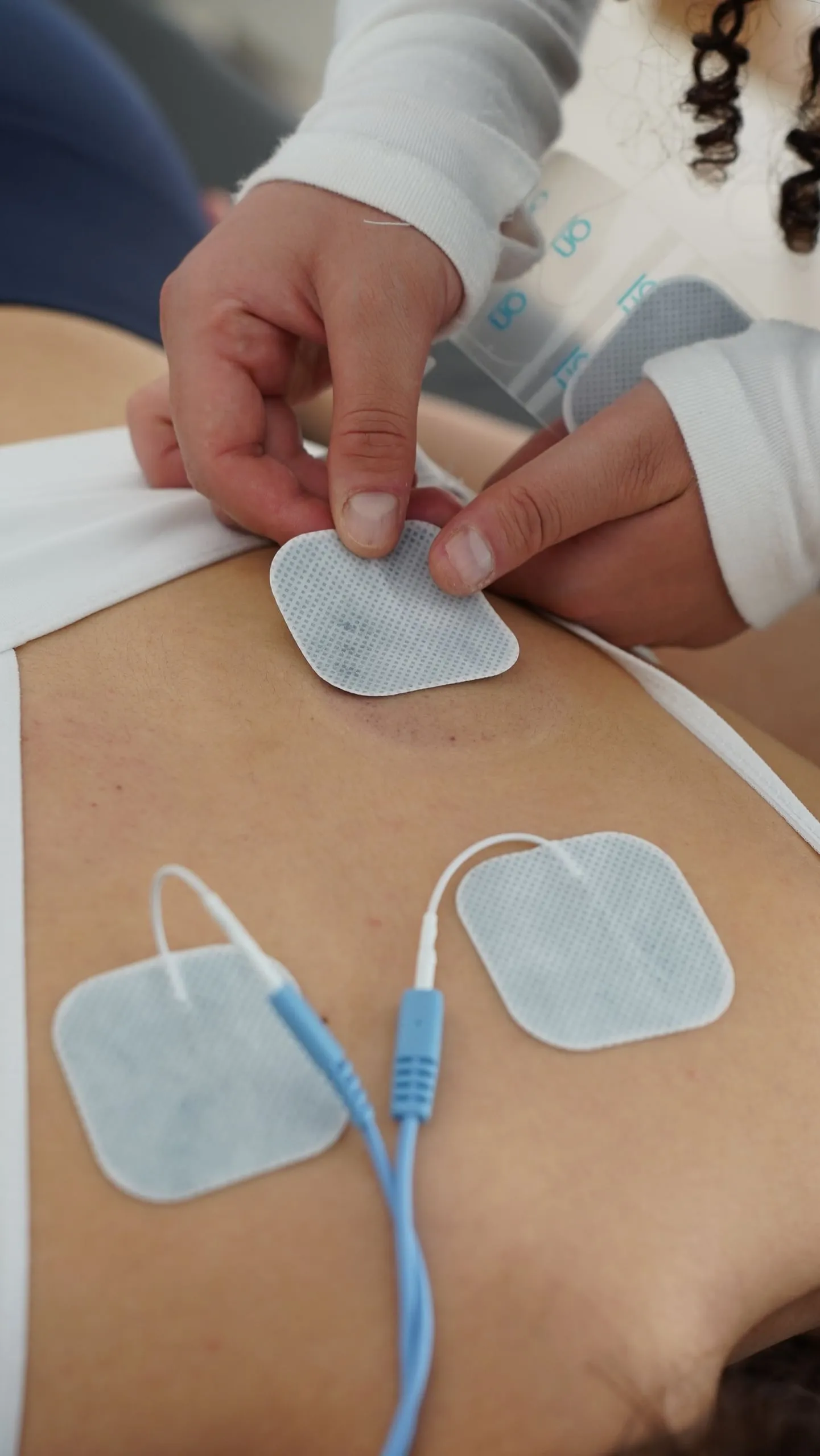
What is the difference between TENS and EMS?
EMS uses stronger stimulation to make muscles contract, and TENS is aimed at pain. A 2023 review in Pain and Therapy puts it this way: “EMS has a similar design to TENS but with stronger stimulation intensity which causes muscle contractions.” Both send current through electrode pads on the skin.
The words on your device may not match this simple split. Your device’s manual and your clinician can tell you what your buttons do.
What does each term mean?
The table uses wording from the 2023 review (Pain and Therapy, PMC10616008), with the US federal definition of TENS. Our glossary has pages for TENS, EMS and NMES.
| Term | What the sources say | Main aim they describe |
|---|---|---|
| TENS (transcutaneous electrical nerve stimulation) | 21 CFR 882.5890 defines a TENS device as one “used to apply an electrical current to electrodes on a patient’s skin to treat pain.” The review says TENS is “most commonly being prescribed for temporary relief of neck and low back pain.” | Pain |
| EMS (electrical muscle stimulation) | “EMS has a similar design to TENS but with stronger stimulation intensity which causes muscle contractions.” A 2023 trial in Medicine says EMS “activates muscles through electrical currents, resulting in involuntary muscle contractions.” | Muscle contraction |
| NMES (neuromuscular electrical stimulation) | The review says NMES “is prescribed for physical rehabilitation, mostly for patients with prolonged inpatient immobilization and for muscle strengthening in patients with spinal cord injuries.” | Muscle rehabilitation |
The review groups NMES, FES (functional electrical stimulation) and EMS among forms that “stimulate muscles that may be atrophied by disuse or neurological compromise and are intended primarily for functional rehabilitation and training.” It groups TENS with forms “primarily intended for pain and/or to improve function.”
Why does the label on a button matter?
Because the goal changes the use. A TENS unit is a device for pain. A muscle-contraction mode is a different aim. Your clinician sets the mode for your reason for using the device. Do not pick a mode by guesswork.
The review also notes that evidence differs by type. It says “Ten of 13 reviewed forms of ES have only limited quality evidence for clinically significant reduction of pain or improvement of function.” For EMS it cites a systematic review that “noted an extremely low quality of evidence” for neck and upper back conditions. This is a statement about research quality, not about any person’s result. It is a reason to ask your clinician why a mode was chosen for you.
Does strong TENS cause muscle twitching?
Sometimes, according to University of Iowa Health Care (UIHC). It says to change the intensity to be “strong but comfortable” and notes “This may cause your muscles to contract.” Its FAQ says muscle twitching is OK “as long as it is not uncomfortable,” and that twitching for longer than 30 minutes “may cause them to get tired or sore.”
So muscle movement alone does not mean you are in an EMS mode. Check the name of the mode on the display and in the manual.
How can you tell which mode you are in?
Look at three things: the label on the display, the mode name in the manual, and what your clinician told you to use. If these do not agree, stop and ask before you continue. Do not assume that a button with a muscle or wave symbol matches the terms in this post. The definitions here do not describe any brand’s buttons.
Write down the exact name of each mode on your device when you visit your clinician. Ask them to mark the one they want you to use. This one step removes most of the guesswork, and it gives you a record you can show anyone who helps you at home.
What other terms might you see on a device?
Different brands name modes differently. The terms below come from the same 2023 review. Do not treat their presence on a device as a match to the review.
| Term | What the review says |
|---|---|
| FES (functional electrical stimulation) | The review says FES “has similarly shown effectiveness in rehabilitation of some stroke, SCI, and foot drop outpatients” |
| Interferential current (IFC) | The review compares it with other forms of electrical stimulation; our glossary explains interferential current therapy |
For a full comparison, read our guide on TENS vs EMS, NMES and interferential current.
What should you do before using any mode?
- Read the manual that came with your unit. It explains the buttons for your model.
- Ask your clinician which mode to use, where to place the pads and how often.
- Read the safety rules in our TENS unit safety guide.
- Check the NHS and UIHC lists of people who should not use TENS. Our post on TENS and pacemakers covers one.
- Stop and ask your care team if you get skin irritation, headache, dizziness or nausea, as UIHC advises.
If your device came from a clinician, ask what they ordered and why. A prescription TENS unit needs a clinician’s order. Our guide on how to get a TENS unit explains the usual steps.
Next step
Take your device and its manual to your doctor or physical therapist and ask them to show you each mode. Then call Analgesic Healthcare at (800) 749-1188 or use contact with questions about getting a unit.
Questions people ask
What is the difference between TENS and EMS?
A 2023 review in Pain and Therapy says EMS has a similar design to TENS but with stronger stimulation intensity which causes muscle contractions. It describes TENS as most commonly prescribed for temporary relief of neck and low back pain.
What does NMES stand for?
NMES stands for neuromuscular electrical stimulation. The same 2023 review says NMES is prescribed for physical rehabilitation, mostly for patients with prolonged inpatient immobilization and for muscle strengthening in patients with spinal cord injuries.
Can I use the EMS button for pain?
Ask your clinician. The 2023 review groups EMS with forms of stimulation intended primarily for functional rehabilitation and training, and TENS with those intended for pain. Follow your clinician's and your device's instructions.
Terms on this page
Sources
- PMC (Pain and Therapy, 2023): Do Electrical Stimulation Devices Reduce Pain and Improve Function? A Comparative Review
- PMC (Medicine, 2023): Effects of electrical muscle stimulation on core muscle activation and physical performance in non-athletic adults
- eCFR: 21 CFR 882.5890 Transcutaneous electrical nerve stimulator for pain relief
- University of Iowa Health Care: Transcutaneous electrical nerve stimulator (TENS)
Checked against the sources above on October 26, 2026. Coverage rules change, so check the linked page or your plan before you act.
This page gives general information, not medical advice. Talk with your doctor or physical therapist about your own care, and follow your clinician's and your device's instructions. In an emergency, call 911.