
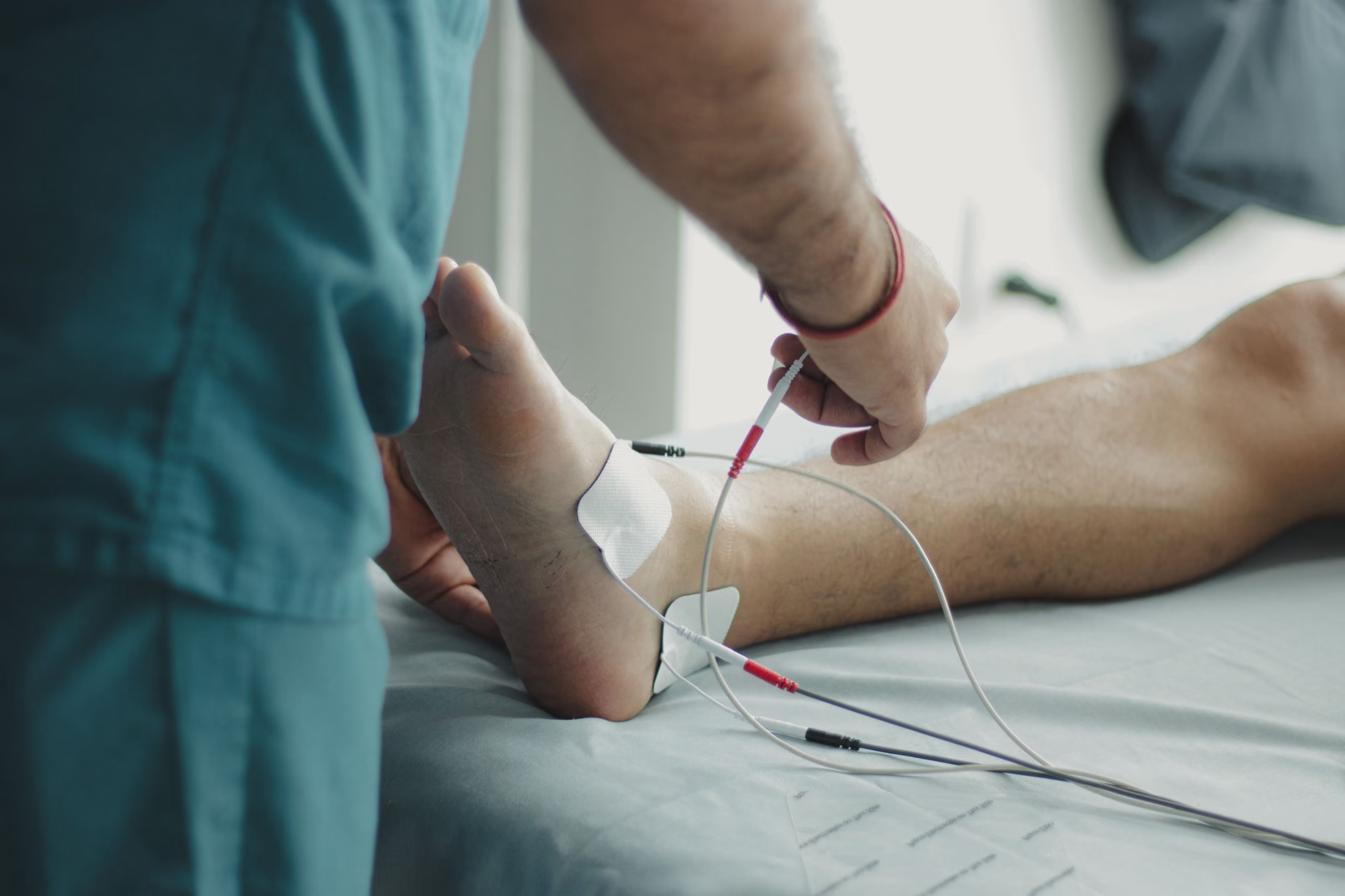
What is a TENS unit?
A TENS unit is a small, portable device that sends mild electrical pulses through pads on your skin to treat pain. TENS stands for transcutaneous electrical nerve stimulation. “Transcutaneous” means “through the skin.”
The FDA describes it in federal regulation 21 CFR 882.5890. That rule says a TENS device for pain relief is “used to apply an electrical current to electrodes on a patient’s skin to treat pain.” The same rule lists its classification as “Class II (performance standards).”
The NHS gives a plain description. It says a TENS machine “passes a weak electrical current to your nerves which can help ease pain.” The NHS also says the treatment gives temporary pain relief.
Most units look alike. A TENS unit has a control box with a screen or dial, lead wires, and sticky electrode pads that you place on clean skin near the painful area. A battery powers the box. Some units use rechargeable batteries.
How does a TENS unit relieve pain?
Scientists do not know exactly how TENS works. Two ideas exist. Both are described as theories.
The NHS says TENS is “thought to work by encouraging your body to release natural painkillers called endorphins and by stopping pain messages from your nerves reaching your brain.” University of Iowa Health Care gives a similar account. It says the pulses “can release endorphins and other substances to stop pain signals in the brain.”
Endorphins are natural painkillers your body makes.
| Idea | Plain meaning | Who describes it |
|---|---|---|
| Endorphin release | Your body makes its own natural painkillers when the nerves are stimulated | NHS; University of Iowa Health Care |
| Blocked pain messages | Pain signals are stopped before they reach the brain | NHS; University of Iowa Health Care |
Neither the NHS nor University of Iowa Health Care promises that TENS will work for you. Read on for what the research says.
Does a TENS unit really work?
A TENS unit may help some people. The size of the effect is uncertain. The NHS says plainly: “TENS does not work for everyone.”
A 2022 review in the journal Medicina (Vance and colleagues, in PubMed Central) looked at the research. It says TENS “may have efficacy for a variety of acute and chronic pain conditions, although the magnitude of the effect remains uncertain due to the low quality of existing literature.” In other words, many studies were small or weak. That makes the true benefit hard to state.
The same review says “stimulation intensity has been documented as critical to therapeutic success.” That fits what clinics teach: a unit set too low may not help.
Medicare takes a firm line on one use. For chronic low back pain, the Medicare TENS policy (LCD L33802) says TENS “will be denied as not reasonable and necessary.” The coverage guide explains this in full. CMS also cites a 2010 American Academy of Neurology report that found TENS ineffective for chronic low back pain. Coverage rules and clinical advice are different things. Ask your clinician what makes sense for you.
For these reasons, we say only that TENS may help some people. A trial with your clinician is one way to find out. Read the insurance coverage guide for how Medicare treats trials.
What does TENS feel like, and how do I know the intensity is right?
TENS should feel like tingling, not pain. The NHS says to turn the dial slowly until you feel a tingling sensation. It adds: “It should not be painful.”
University of Iowa Health Care lists other normal feelings. You may feel “tingling, tapping, buzzing, or muscle twitching.” The sensation may also seem stronger or weaker at times. After a few minutes, the feeling can fade as your body gets used to it. The page says you can then turn the stimulation intensity up so it stays strong but comfortable.
The same page also warns against going too low. It says it is not OK to turn it up to where you “just barely feel it,” because “research shows this will not provide pain relief.”
Use this quick check each time you start:
- Turn the unit off before you put on or move the pads.
- Place the pads on clean, dry skin, as your clinician showed you.
- Turn the unit on at the lowest setting.
- Raise the intensity slowly until you feel a strong but comfortable tingle.
- Stop and call your clinician if you feel pain, skin irritation, headache, dizziness, or nausea.
Follow your clinician’s and your device’s instructions. They override this page. Where to place the pads depends on your pain, so see our pad placement guide and ask for a demonstration.
How often and how long can I use a TENS unit?
Follow your clinician’s and your device’s instructions. No single schedule fits everyone.
University of Iowa Health Care gives some general facts. It says “Research has shown that TENS is most helpful for chronic pain when used for at least 30 minutes while you are active.” It adds that TENS is “less effective when you are sitting still, lying down, or resting.” It names walking, doing chores, and exercise as good times to use it.
The same page covers rest days. It says: “You can take a break; 3 to 5 days off may be helpful.” If pain is at a manageable level, you may wait until a flare-up. It also says that “Some people use their TENS only when their pain is most severe, while others use it daily.”
Some limits are firm. Do not use TENS while you sleep, in the bath or shower, or while driving or using machinery. Both the NHS and University of Iowa Health Care say this. Read the full list in the TENS unit safety guide.
Also note: Medicare’s TENS policy describes a trial of at least 30 days and no more than two months for chronic pain, with a treating practitioner who monitors results.
What is in the box, and what are channels, leads, and pads?
A typical kit has a control unit, lead wires, electrode pads, and a power source. University of Iowa Health Care describes one example package. It lists a dual-channel TENS unit, “Two wires with a total of 4 connectors,” four electrode patches, batteries, and a belt clip. Your kit may differ.
| Part | What it does |
|---|---|
| Control unit | Makes the pulses; holds the dial or buttons for intensity |
| Channel | One output circuit; a dual-channel unit supports up to four pads |
| Lead wires | Carry the pulses from the unit to the pads |
| Electrode pads | Stick to the skin and pass the current into your body |
| Power source | Alkaline or rechargeable batteries |
| Belt clip or pouch | Keeps the unit on you during activity |
University of Iowa Health Care advises: “Pick a model with dual (2) channels. This will let you put on up to 4 patches.” That page also notes pads wear out, so check that replacements are easy to get. The page gives pad care steps. Clean skin and storage in the bag help pads stick longer.
Never share your pads or your unit. University of Iowa Health Care says: “Do not share your patches with other people.”
Is a TENS unit worth it?
Only you and your clinician can decide that. There are facts to weigh, not a verdict.
On the benefit side, the 2022 review says TENS may help with many pain conditions, but the size of the effect is uncertain. The NHS says TENS does not work for everyone. On the cost side, University of Iowa Health Care lists what you pay for: “the TENS unit, replacement patches, and batteries as you need them.” It adds that patches “may last up to 2 weeks.”
Coverage also matters. The same page says TENS units are “not routinely covered by insurance, but all companies have different policies.” Medicare covers TENS only in set cases. Our insurance coverage guide shows which ones.
A trial helps you judge value before you commit. Ask your clinician how long a trial should last and what result would count as helpful. Write down the goal first, such as walking farther. Then check your log at the end of the trial.
What if my TENS unit is not working?
Check the simple things first. University of Iowa Health Care lists steps for common problems. Turn the unit off before you make any change.
| Problem | What the page suggests |
|---|---|
| You cannot feel the current | Check the batteries, check that the pads stick to your body, and check that the wires are plugged into the pad and the unit |
| Pads will not stay on | Wet a fingertip and gently rub the pad surface, let it dry for 60 seconds, and try again; if that fails, use new pads |
| Little or no pain relief | Try a different setting or a different pad position, and call your health care team if you cannot get relief |
| Skin irritation | Call your health care team if you have redness, a rash, or itching in the first 24 hours; move the pads to a different site |
The page also says that if you get no relief, you can stop for 3 to 5 days and then try again. Follow your clinician’s advice first, because they know your history. If a problem continues, call your clinician. The TENS unit safety guide explains which symptoms mean you should stop.
Who prescribes a TENS unit, and who supplies it?
A licensed clinician, such as a physician or physical therapist, decides if TENS fits your care. A durable medical equipment (DME) supplier then provides the unit and supplies. Medicare counts TENS equipment under its durable medical equipment benefit.
The NHS advises checking with a healthcare professional first, “to make sure TENS is safe for you.” University of Iowa Health Care notes that TENS units can also be bought in stores and online, and adds that insurance does not routinely cover TENS: “all companies have different policies.” Prescription units need a clinician’s order.
Analgesic Healthcare, Inc. is a DME company based at 7823 N. Dale Mabry Highway in Tampa, Florida. AHC says it has served patients since 1978. It is accredited by the Accreditation Commission for Health Care (ACHC). It offers a preauthorization form for TENS units for doctors and physical therapists. See how to get a TENS unit for the steps.
What should I ask my clinician before I start?
Bring a short list to your visit. Good questions help you and your clinician choose a plan.
- Is TENS safe for me? Do I have a pacemaker, another implanted device, epilepsy, or am I pregnant?
- What type of pain do I have, and what causes it?
- Where should the pads go on my body? Can you show me?
- How long and how often should I use the unit at first?
- What should I do if my skin gets red or itchy?
- How will we judge if TENS helps? What will we track?
- What other treatments should I use alongside TENS?
- Will my insurance or Medicare cover the unit, and what paperwork do you need?
Write the answers down. University of Iowa Health Care tells patients to follow “the treatment program in your After Visit Summary.” Keep a simple log of when you used the unit and how you felt. Your clinician can use it to review your progress.
Never start or stop a medicine because of TENS without talking to your clinician.
Where can I learn more about my pain area?
Pain from different body areas raises different questions. University of Iowa Health Care says TENS may be used for many types of chronic pain, such as “Arthritis or other joint pain,” “Back and neck pain,” “Fibromyalgia,” “Muscle pain,” and “Neuropathic pain.” The NHS lists sports injuries and pain from conditions such as arthritis.
Our pain areas hub links to pages on back, head and neck, upper extremity, lower extremity, and systemic pain. Each page says what TENS can and cannot do for that area, and where Medicare coverage differs.
Remember the coverage limits. Medicare’s policy names headache as a condition for which TENS is not reasonable and necessary, and it denies TENS for chronic low back pain. Your own plan may differ, so check with it.
Next step
Talk with your clinician about whether TENS fits your pain. When you are ready to ask about a TENS unit, call Analgesic Healthcare at (800) 749-1188 or use our contact page.
Questions people ask
What is a TENS unit and how does it work?
A TENS unit is a small device that sends mild electrical pulses through electrode pads on your skin. The NHS says it is thought to work by helping your body release endorphins, its own natural painkillers, and by stopping pain messages from your nerves reaching your brain.
Does a TENS unit really work?
It may help some people. A 2022 review in the journal Medicina concluded TENS may have efficacy for many acute and chronic pain conditions, but the size of the effect is uncertain because the studies are low in quality. The NHS says TENS does not work for everyone.
Is a TENS unit worth it?
That depends on your pain, your clinician's advice, and what you can try first. Many programs use a trial period so you can see if the unit helps before you commit. Talk with your clinician about your goals and about cost, coverage, and replacement supplies.
How often can you use a TENS unit?
Follow your clinician's and your device's instructions. University of Iowa Health Care says some people use TENS only when pain is at its worst, and others use it every day. It also says a break of 3 to 5 days can be helpful.
How long should I leave a TENS unit on?
Follow your clinician's and your device's instructions. University of Iowa Health Care says research shows TENS is most helpful for chronic pain when used for at least 30 minutes while you are active. Never use it while you sleep, bathe, or drive.
Should a TENS unit hurt?
No. The NHS says the dial should be turned up slowly until you feel a tingling sensation, and that it should not be painful. University of Iowa Health Care says to aim for strong but comfortable. Stop and call your clinician if you have a problem.
Terms on this page
Sources
- eCFR: 21 CFR 882.5890, Transcutaneous electrical nerve stimulator for pain relief
- NHS: TENS (transcutaneous electrical nerve stimulation)
- University of Iowa Health Care: Transcutaneous electrical nerve stimulator (TENS)
- PubMed Central: Using TENS for Pain Control: Update on the State of the Evidence
- CMS Medicare Coverage Database: LCD L33802, Transcutaneous Electrical Nerve Stimulators (TENS)
- CMS Medicare Coverage Database: Policy Article A52520, TENS
- CMS: Transmittal R149NCD, NCD 160.27 TENS for chronic low back pain
Checked against the sources above on October 26, 2026. Coverage rules change, so check the linked page or your plan before you act.
This page gives general information, not medical advice. Talk with your doctor or physical therapist about your own care, and follow your clinician's and your device's instructions. In an emergency, call 911.